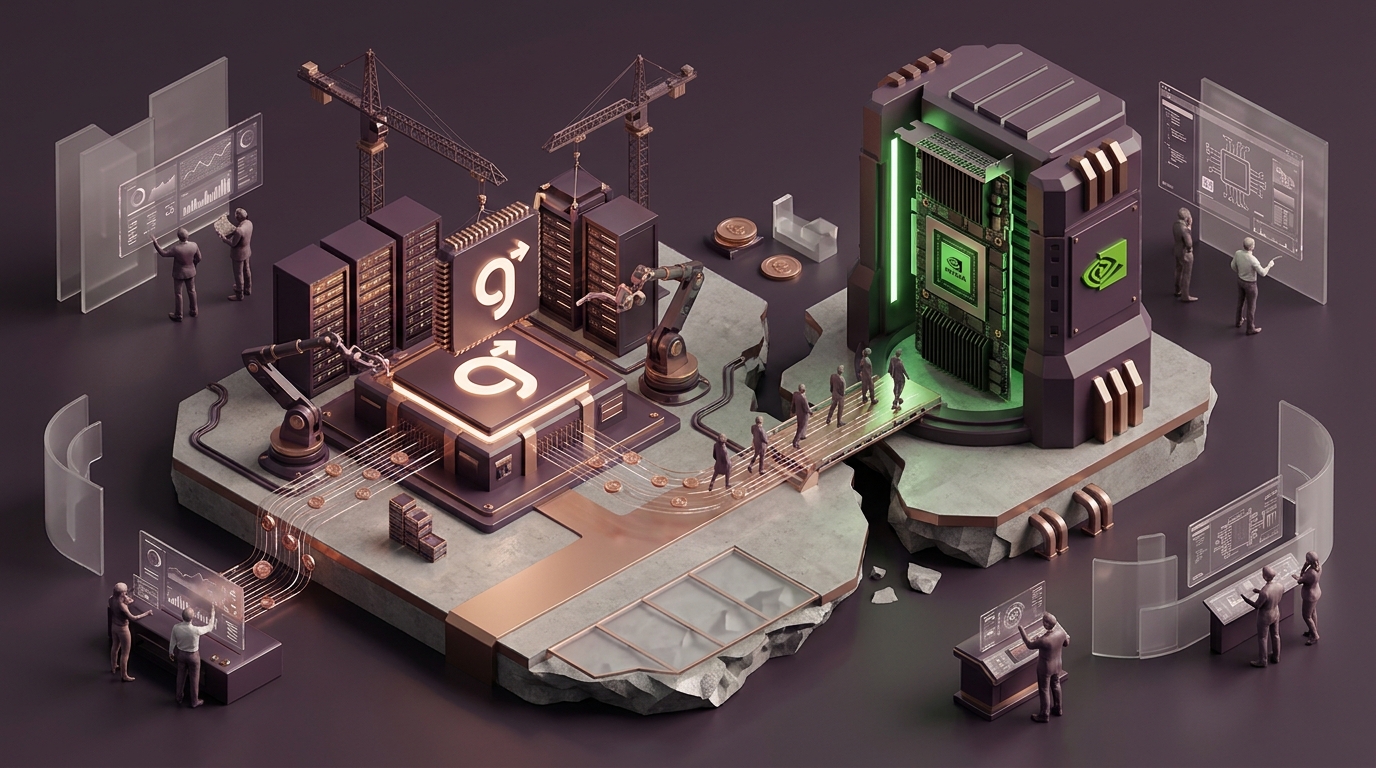

Groq secured $650 million in fresh capital to rebuild its executive team after Nvidia executed a $20 billion talent raid. While public attention fixates on consumer software like Grok AI, the actual existential battle in tech is happening at the silicon layer. Incumbents are bypassing antitrust scrutiny by buying the engineers instead of the companies. This leaves hardware and neocloud startups in a precarious position. You either build a structural moat around your talent or you become an unpaid recruiting pipeline for a trillion-dollar monopoly.
The TechCrunch report from June 2026 confirms that Groq survived what should have been a fatal corporate blow. Nvidia effectively hollowed out Groq's engineering and leadership ranks without acquiring the underlying intellectual property. Groq responded by raising a massive round and installing a new leadership team. This is not just a survival story. It provides a concrete playbook for how deep tech companies can recapitalize and pivot when a dominant player strips their core human assets.

The Mechanics of the Not-Acqui-Hire
Nvidia spent $20 billion to acquire talent without triggering a Federal Trade Commission review of a formal merger. This maneuver isolates the intellectual property from the brains that created it.
Traditional acquisitions trigger regulatory alarms. When a market leader tries to buy a rising competitor, regulators block the deal to preserve competition. The new incumbent strategy bypasses the boardroom entirely. You do not buy the competitor. You simply offer the competitor's entire engineering department compensation packages they cannot refuse.
Founders must understand the stark differences between these two exit paths:
- Traditional Acquisition: The incumbent buys the corporate entity. They acquire the revenue, the intellectual property, the customer contracts, and the liabilities. Regulators scrutinize the deal to ensure it does not create a monopoly. Founders and investors get a clean exit.
- The Not-Acqui-Hire: The incumbent targets the engineering department directly. They offer massive compensation packages to the individuals. The corporate entity, the legacy intellectual property, and the liabilities are left behind. Regulators have little authority to block individuals from accepting new jobs. The startup is left gutted, and investors hold equity in an empty shell.
Groq faced this exact sudden vacuum. Their LPU (Language Processing Unit) architecture remained intact, but the visionaries who understood its deepest optimizations were gone. For founders, this introduces a terrifying reality. Your non-compete agreements are likely unenforceable. Your equity vesting schedules might not deter a competitor willing to issue massive sign-on bonuses to offset unvested shares.
Why Groq's Survival Matters for Operators
Founders must treat talent retention as a structural defense mechanism rather than a human resources function. If your entire product roadmap lives in the heads of three engineers, your company is highly vulnerable.
Investors backed Groq's $650 million raise because the market desperately needs an alternative to Nvidia. The capital markets are willing to fund a rebuild if the underlying technology solves a critical bottleneck. AI inference is that bottleneck. Running large language models at scale requires specialized silicon.
The demand for inference compute is staggering. Every time a consumer queries a massive model, servers burn through compute cycles. The industry needs faster, cheaper ways to generate tokens. Groq built an architecture specifically designed for this task. GPUs were built for parallel processing of graphics and happen to be good at AI training. LPUs are designed specifically for sequential processing, which is exactly what token generation requires. Investors looked at the empty desks at Groq and decided the intellectual property alone was worth saving.
Clarifying the Market: Groq vs Grok AI
The industry frequently confuses Groq the hardware manufacturer with Grok AI the software application. Understanding the distinction reveals where the real value accrues in the technology stack.
We need to separate the silicon from the software. Groq is a hardware company building chips optimized for fast AI inference. Grok AI is a large language model developed by xAI. They share a phonetic name but occupy opposite ends of the infrastructure stack.
When users ask what is special about Grok AI, they are looking at the application layer. The software differentiates itself through real-time access to social data and a distinct conversational tone. Most large language models are trained on static datasets with a defined cutoff date. Grok AI processes real-time social streams, allowing it to surface information about unfolding events faster than traditional search-based models.
Consumers often wonder if Grok AI is free to use. Access has moved between free and paid tiers as X has adjusted capacity. Paid X tiers carry the highest usage limits. The exact tier requirements shift based on regional rollouts and platform updates. This subscription model creates a direct revenue stream to offset the massive compute costs required to run the model.
This brings us back to the hardware. Grok AI and similar models require massive clusters of GPUs or specialized chips to function. Running a model that processes real-time data at scale is incredibly expensive. Every query requires inference compute. Groq wants to be the hardware that powers these types of models. The confusion between the two names highlights a broader industry truth. Consumers care about the application, but investors care about the infrastructure. The company that controls the silicon dictates the margins for the companies building the software.
The Playbook for Rebuilding After a Talent Raid
Startups must decouple their core technology from individual contributors. When a raid happens, you survive by immediately pivoting your narrative to the value of your proprietary assets.
Groq's ability to raise $650 million after losing its team offers a clear framework for founders. Step one is securing the intellectual property. You must ensure your codebase, hardware designs, and operational procedures are documented and accessible. If your lead architect leaves, the next hire needs to be able to read the blueprints. Institutional knowledge cannot walk out the door at 5 PM.
Step two is trading on anti-monopoly sentiment. Groq went to investors with a simple pitch. Nvidia just proved how valuable our approach is by spending billions to hire our team. If you want to prevent Nvidia from owning the entire future of compute, you must fund us. Investors who missed the Nvidia rally are highly motivated to fund potential challengers. You must position your gutted company not as a victim, but as the only viable alternative to total market consolidation.
Step three is aggressive external recruiting. You cannot promote from within when the inside has been hollowed out. Groq used the new capital to bring in veteran executives from outside the immediate ecosystem. You buy credibility by hiring leaders who have scaled complex hardware operations before. A fresh executive team signals to the market that the company is moving forward, not dwelling on the talent it lost.

The Limits of a Recapitalized Vision
A new executive team inheriting legacy intellectual property faces massive integration risks. Capital buys time but it does not guarantee execution.
The open question for Groq is whether a newly assembled team can execute a roadmap they did not design. Hardware development cycles are notoriously long. A chip architecture designed three years ago might not align with the models being trained today. The new leadership must decide whether to continue the existing LPU development or pivot based on their own expertise.
If they pivot, they risk losing the specific advantages that made Groq valuable in the first place. If they stay the course, they are executing a vision without the original visionaries. This dynamic applies to any startup recovering from a talent raid. The product will inevitably change. Founders must manage investor expectations during this transition. You are essentially running a new company that happens to own the assets of the old one.
The Future of Deep Tech Competition
Incumbents will continue using their balance sheets to neutralize threats before they mature. Startups must build companies designed to withstand aggressive extraction tactics.
The $20 billion Nvidia deal sets a precedent. We will see more dominant companies bypass acquisitions in favor of targeted hiring sprees. Regulators are currently ill-equipped to stop this. A company cannot be forced to stay together if the employees legally choose to accept better offers elsewhere.
Your defense strategy must be structural. Distribute knowledge across teams. Build a culture that values the collective output over individual genius. Maintain deep relationships with capital partners who understand the strategic value of your market position. If your investors panic when your lead engineer leaves, you have the wrong investors.
Groq survived the first major battle of this new corporate warfare. Their next challenge is shipping silicon that proves the investors right. The hardware market does not reward survival. It rewards performance. The $650 million is not a victory lap. It is a war chest to build the next generation of infrastructure.
Navigating these aggressive market dynamics requires a clear strategy for talent retention and capital deployment. If you are building in a highly competitive sector and need to pressure-test your structural defenses, book a call.
Maurizio Cavalieri is the Founder & CEO of LevelThree Co, established in 2019, he has worked in the industry for over 13 years developing software.
LinkedInFrequently asked questions
Is Grok AI free to use?
Access has moved between free and paid tiers as X has adjusted capacity. The highest usage limits sit behind a paid X subscription.
Is Grok AI owned by Elon Musk?
Yes, the model is developed by xAI, an artificial intelligence company founded and controlled by Elon Musk.
What's special about Grok AI?
The model differentiates itself through real-time access to social data streams on the X platform, allowing it to process and discuss unfolding events faster than models relying on static training data.
How do hardware talent raids affect AI development?
When incumbents poach specialized engineering teams from startups, it delays the development of alternative silicon architectures, forcing the industry to rely on existing monopoly hardware for longer periods.
Sources
Signals, not noise.
- Field notes from real client builds
- Pricing, process & AI takes, unfiltered
- No spam. Unsubscribe in one click.